
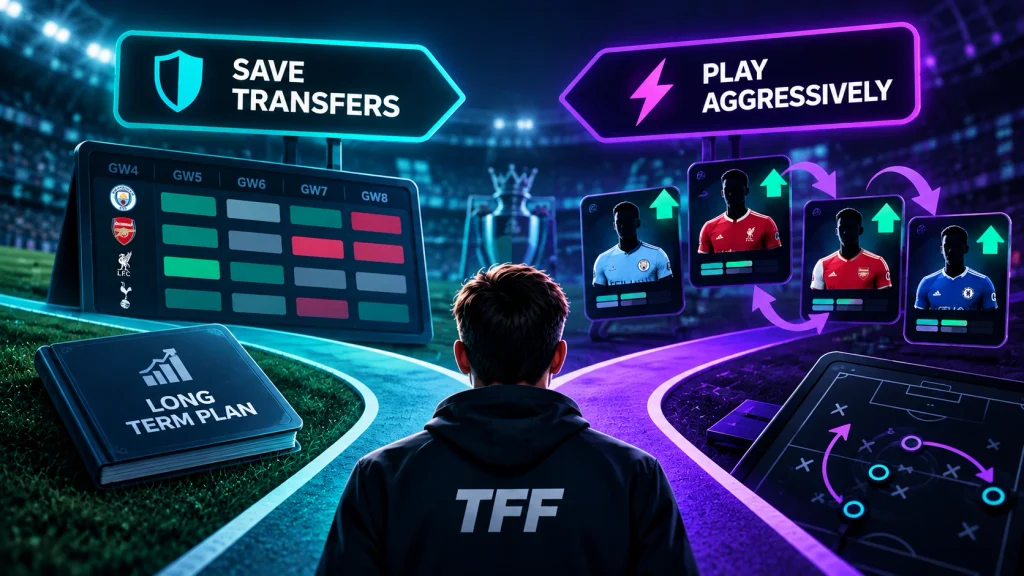
One of the hardest decisions in Telegraph Fantasy Football isn’t who to transfer in.
It’s deciding whether to make a transfer at all.
Use too many early and you can leave yourself short later in the season. Save too many and you might watch valuable opportunities pass you by.
So which approach is better?
The answer is somewhere in the middle.
The Case for Saving Transfers
Transfers are one of your most valuable resources in TFF.
Every transfer you save gives you flexibility later.
Players get injured. Suspensions happen. Fixtures move. Cup competitions create extra games. A player who looks essential today can suddenly lose their place a few weeks later.
Having transfers available means you can react.
This is particularly important towards the latter stages of the season, when fixture schedules can become more complicated and every decision feels more significant.
If you’ve already burned through most of your transfers, you might spot a brilliant opportunity but simply not have the moves available to take advantage of it.
That’s the argument for patience.
But patience can go too far.
Saving Transfers Doesn’t Score Points
There’s no prize for finishing the season with transfers left.
If a transfer gives you a genuine opportunity to improve your team, refusing to make it simply because you want to protect your transfer count can be just as damaging as using too many.
Imagine one of your players has a difficult run ahead.
Another player at a similar price has good fixtures, strong form and perhaps an additional cup match.
Keeping your transfer might save you one move.
But what points are you potentially giving up?
That’s why transfer conservation shouldn’t become the entire strategy.
When Being Aggressive Makes Sense
There are times when attacking the fixture schedule can be extremely effective.
You might spot a 2-for-0, where your incoming player can play twice before the outgoing player plays again.
Perhaps there’s an injury that gives another player a run of guaranteed starts.
Or maybe you’ve identified a player entering several excellent fixtures while someone in your team is heading into a difficult spell.
Those are very different from transferring someone simply because they blanked at the weekend.
Aggressive TFF management works best when there’s a clear reason behind the move.
You’re not just making more transfers.
You’re trying to get more value from each transfer.
Don’t Confuse Activity With Strategy
This is where it can go wrong.
TFF gives you plenty of opportunities to make changes, particularly because kick-off times can create additional transfer windows throughout a weekend.
That doesn’t mean you need to use them.
A Saturday lunchtime blank can suddenly make a Sunday player look incredibly tempting.
Then that player blanks too.
Now you’re looking at Monday night’s match.
Before you know it, you’ve used several transfers and haven’t meaningfully improved your team.
Sometimes the aggressive move is right.
Sometimes doing absolutely nothing is the better decision.
Think About What You’re Buying
Rather than asking:
“Is this player better?”
Try asking:
“What am I getting for this transfer?”
Maybe you’re getting an extra fixture.
Maybe you’re getting four favourable matches.
Maybe you’re replacing an injured player with someone likely to start regularly.
Or perhaps you’re simply reacting to one good performance.
Those are very different reasons to spend a transfer.
The more value you can get from each move, the less important the debate between being “aggressive” or “conservative” becomes.
Your Position Matters Too
Your strategy doesn’t have to remain the same all season.
If you’re happy with your team and have plenty of transfers available, there may be no reason to force moves.
If you’re chasing in a mini-league later in the season, you might decide that taking a few more calculated risks is worthwhile.
Likewise, if you’re protecting a strong position, keeping flexibility could become more valuable.
The situation changes.
Your strategy should be able to change with it.
Plan the Move Before You Make It
This is where looking ahead becomes particularly useful.
Before using a transfer, check what happens over the next few fixtures rather than just the next match.
How many games does the incoming player have?
When are they playing?
Are there cup fixtures involved?
Would you still want that player in your team afterwards?
And could making this transfer create another good move later?
That’s something you can map out in PlanTFF before touching your actual TFF team.
You can plan future transfers, look ahead at fixture sequences and kick-off times, and see how different moves affect your squad and budget.
And it’s completely free.
So, Save or Attack?
Neither approach should become a rule.
Don’t burn transfers simply because an opportunity exists.
But don’t become so protective of them that you miss good opportunities either.
A transfer that genuinely improves your team, gives you additional fixtures or sets up a strong run can be worth using.
A transfer made because you’re frustrated about yesterday’s points probably isn’t.
The goal isn’t to use the fewest transfers.
And it isn’t to use the most.
It’s to make every transfer earn its place.